Crypto payment gateways face constant challenges around fraud detection, revenue leakage, chargebacks, and reconciliation across fiat and blockchain transactions. Existing dashboards are fragmented, reactive, and lack predictive insights that financial teams need to act with confidence.
YEAR
2025
ROLE
PRODUCT DESIGNER
SERVICES
UX RESEARCH
PRODUCT DESIGN
BRAND DESIGN
About the project
Category Positioning:
Finance & Accounting → Financial Intelligence / Reconciliation Tools
Analytics & Reporting Platforms → Real-time BI Dashboards
AI & Automation → Risk Profiling, Predictive Analytics, Fraud Detection
Payments & Transaction Infrastructure → Crypto Gateways
Problem Statement:
Crypto payment companies lack consolidated tools to monitor merchant performance, prevent fraud, and forecast cash flow across both fiat and crypto channels. Existing solutions are fragmented, reactive, and provide little predictive intelligence.
Solution:
A real-time AI SaaS dashboard for crypto gateways offering:
Smart Merchant Profiling: Risk scoring, growth potential, and anomaly flags.
Transaction Intelligence: Real-time fraud/anomaly detection.
Revenue Intelligence: Reconciliation across fiat/crypto channels, forecasting leakage.
Engagement Metrics: Stickiness, churn probability, ROI health.
Target Users:
Crypto Payment Processors → needing fraud detection + revenue reconciliation.
Web3 Commerce Platforms → requiring merchant profiling + retention metrics.
On/Off-Ramp Providers → seeking real-time visibility across fiat and crypto rails.
My Role:
UX & Product Designer → Led the concept design, UX audit, and interaction mapping.
Conducted competitive benchmarking against BI and payment platforms.
Designed dashboard layouts, data hierarchies, and accessibility improvements.
Applied “outside-the-box” UX audit models (H.E.A.T, Cognitive Load Simulation, Loop Fatigue, etc.).
Impact:
Simplifies merchant risk monitoring by consolidating multiple KPIs.
Reduces investigation time with anomaly clustering and smart alerts.
Improves revenue recovery by detecting hidden leakage in real-time.
Increases decision confidence with predictive churn and ROI simulations.
UX Audit of the Concept Dashboard
Strengths
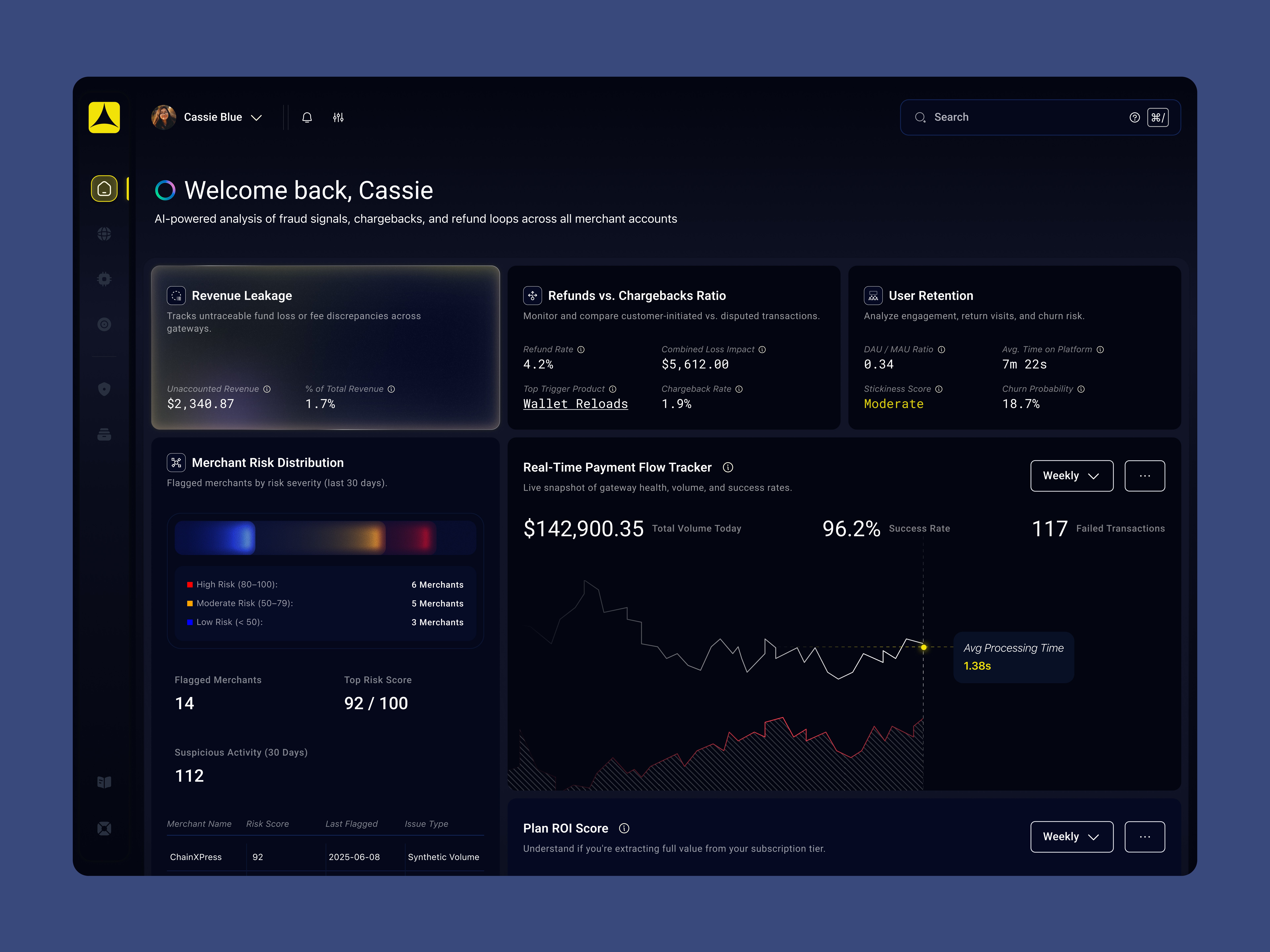
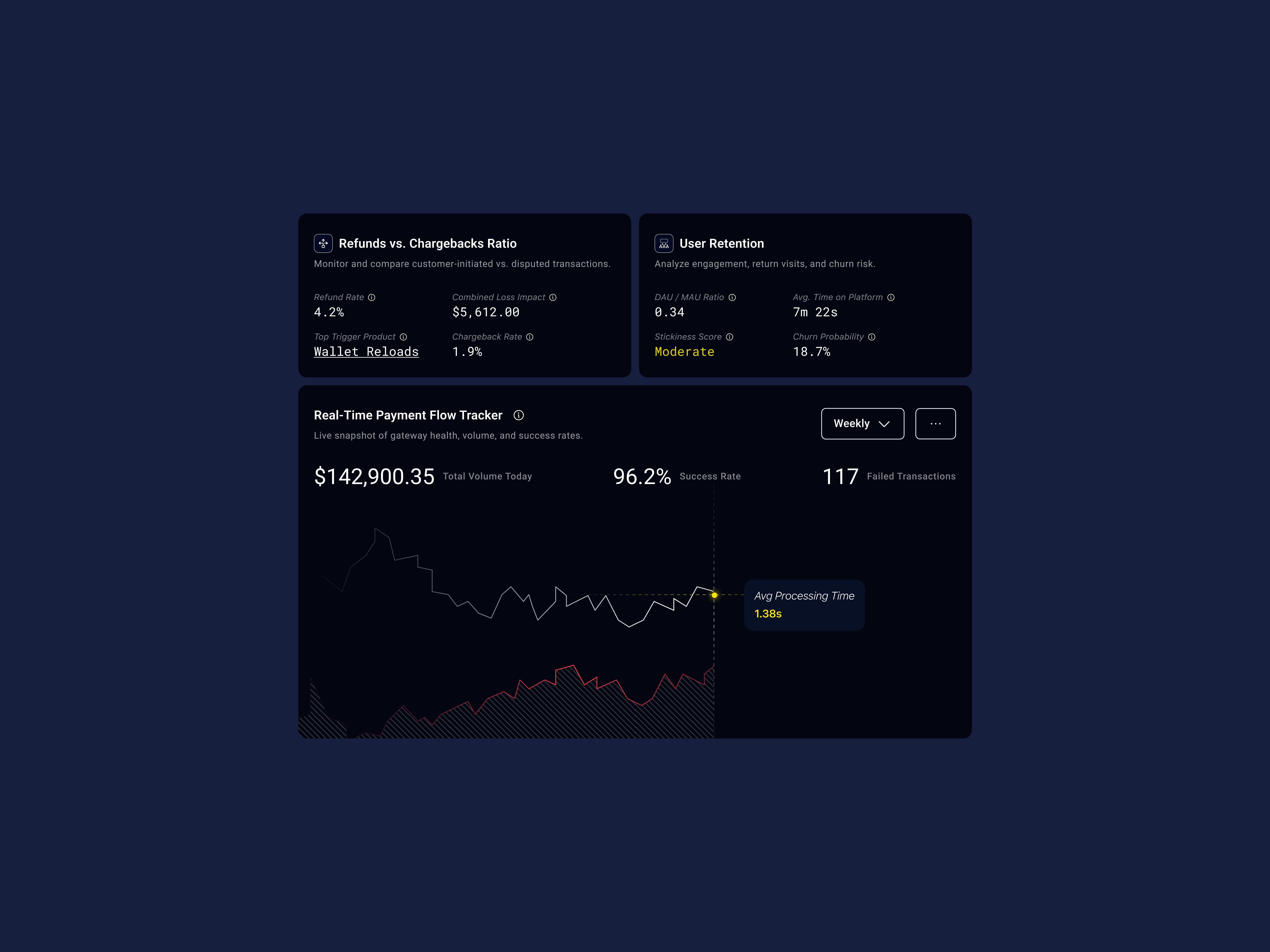
✔ Clear Hierarchy & Layout: KPIs (Revenue Leakage, Chargeback Ratio, User Retention) are given prominence in a 3-card top section. This mirrors mental models of financial teams who prioritize loss, disputes, retention.
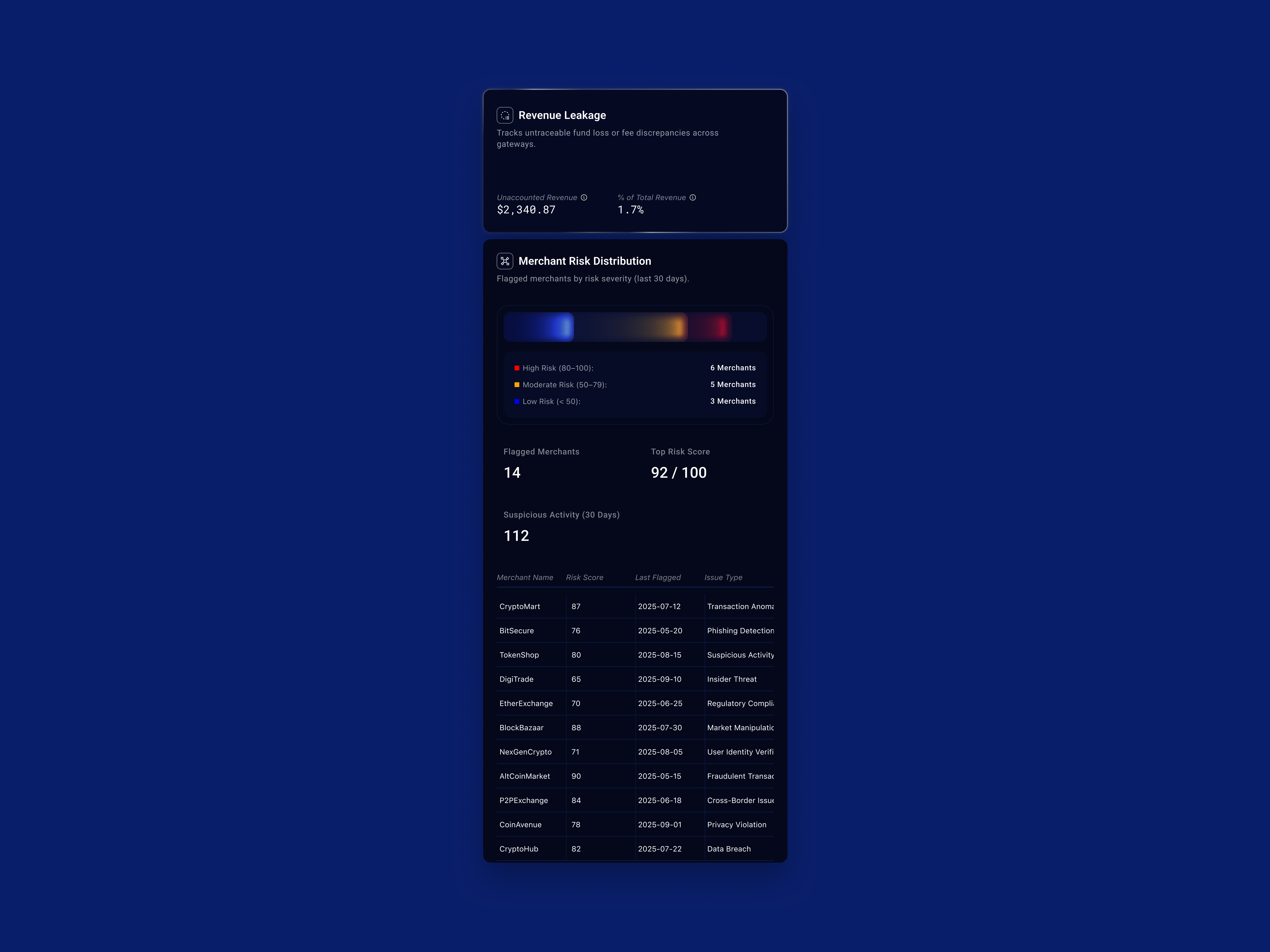
✔ Color-Coded Risk Distribution: The heatmap gradient (high risk → low risk) provides immediate scanning for anomalies. Risk scores and flagged merchants are contextualized with recent activity.
✔ Real-Time Payment Flow Tracker: Combines volume, success rate, and failed transactions into a single snapshot, reducing context-switching.
✔ Micro-Interactions (tooltips, inline labels): Small info icons next to KPIs reduce cognitive overload for non-experts.
✔ User-Centric Personalization: Greeting the user ("Welcome back, Cassie") fosters familiarity and user identity within the system.
Competitive Advantage
Compared to traditional BI dashboards (Tableau, PowerBI) and payment analytics tools, this concept:
Uses AI anomaly detection instead of manual thresholds.
Provides crypto–fiat reconciliation (unique pain point in Web3 commerce).
Adds real-time loop visibility for fraud and chargebacks.

Smooth Scroll
This will hide itself!
This will hide itself!
AI-Powered Financial Intelligence SaaS - Crypto Payment Gateway
OVERVIEW
Crypto payment gateways face constant challenges around fraud detection, revenue leakage, chargebacks, and reconciliation across fiat and blockchain transactions. Existing dashboards are fragmented, reactive, and lack predictive insights that financial teams need to act with confidence.
YEAR
2025
ROLE
PRODUCT DESIGNER
SERVICES
UX RESEARCH
PRODUCT DESIGN
BRAND DESIGN
About the project
Category Positioning:
Finance & Accounting → Financial Intelligence / Reconciliation Tools
Analytics & Reporting Platforms → Real-time BI Dashboards
AI & Automation → Risk Profiling, Predictive Analytics, Fraud Detection
Payments & Transaction Infrastructure → Crypto Gateways
Problem Statement:
Crypto payment companies lack consolidated tools to monitor merchant performance, prevent fraud, and forecast cash flow across both fiat and crypto channels. Existing solutions are fragmented, reactive, and provide little predictive intelligence.
Solution:
A real-time AI SaaS dashboard for crypto gateways offering:
Smart Merchant Profiling: Risk scoring, growth potential, and anomaly flags.
Transaction Intelligence: Real-time fraud/anomaly detection.
Revenue Intelligence: Reconciliation across fiat/crypto channels, forecasting leakage.
Engagement Metrics: Stickiness, churn probability, ROI health.
Target Users:
Crypto Payment Processors → needing fraud detection + revenue reconciliation.
Web3 Commerce Platforms → requiring merchant profiling + retention metrics.
On/Off-Ramp Providers → seeking real-time visibility across fiat and crypto rails.
My Role:
UX & Product Designer → Led the concept design, UX audit, and interaction mapping.
Conducted competitive benchmarking against BI and payment platforms.
Designed dashboard layouts, data hierarchies, and accessibility improvements.
Applied “outside-the-box” UX audit models (H.E.A.T, Cognitive Load Simulation, Loop Fatigue, etc.).
Impact:
Simplifies merchant risk monitoring by consolidating multiple KPIs.
Reduces investigation time with anomaly clustering and smart alerts.
Improves revenue recovery by detecting hidden leakage in real-time.
Increases decision confidence with predictive churn and ROI simulations.
UX Audit of the Concept Dashboard
Strengths
✔ Clear Hierarchy & Layout: KPIs (Revenue Leakage, Chargeback Ratio, User Retention) are given prominence in a 3-card top section. This mirrors mental models of financial teams who prioritize loss, disputes, retention.
✔ Color-Coded Risk Distribution: The heatmap gradient (high risk → low risk) provides immediate scanning for anomalies. Risk scores and flagged merchants are contextualized with recent activity.
✔ Real-Time Payment Flow Tracker: Combines volume, success rate, and failed transactions into a single snapshot, reducing context-switching.
✔ Micro-Interactions (tooltips, inline labels): Small info icons next to KPIs reduce cognitive overload for non-experts.
✔ User-Centric Personalization: Greeting the user ("Welcome back, Cassie") fosters familiarity and user identity within the system.
Competitive Advantage
Compared to traditional BI dashboards (Tableau, PowerBI) and payment analytics tools, this concept:
Uses AI anomaly detection instead of manual thresholds.
Provides crypto–fiat reconciliation (unique pain point in Web3 commerce).
Adds real-time loop visibility for fraud and chargebacks.
Smooth Scroll
This will hide itself!
This will hide itself!
AI-Powered Financial Intelligence SaaS - Crypto Payment Gateway
OVERVIEW
Crypto payment gateways face constant challenges around fraud detection, revenue leakage, chargebacks, and reconciliation across fiat and blockchain transactions. Existing dashboards are fragmented, reactive, and lack predictive insights that financial teams need to act with confidence.
YEAR
2025
ROLE
PRODUCT DESIGNER
SERVICES
UX RESEARCH
PRODUCT DESIGN
BRAND DESIGN
About the project
Category Positioning:
Finance & Accounting → Financial Intelligence / Reconciliation Tools
Analytics & Reporting Platforms → Real-time BI Dashboards
AI & Automation → Risk Profiling, Predictive Analytics, Fraud Detection
Payments & Transaction Infrastructure → Crypto Gateways
Problem Statement:
Crypto payment companies lack consolidated tools to monitor merchant performance, prevent fraud, and forecast cash flow across both fiat and crypto channels. Existing solutions are fragmented, reactive, and provide little predictive intelligence.
Solution:
A real-time AI SaaS dashboard for crypto gateways offering:
Smart Merchant Profiling: Risk scoring, growth potential, and anomaly flags.
Transaction Intelligence: Real-time fraud/anomaly detection.
Revenue Intelligence: Reconciliation across fiat/crypto channels, forecasting leakage.
Engagement Metrics: Stickiness, churn probability, ROI health.
Target Users:
Crypto Payment Processors → needing fraud detection + revenue reconciliation.
Web3 Commerce Platforms → requiring merchant profiling + retention metrics.
On/Off-Ramp Providers → seeking real-time visibility across fiat and crypto rails.
My Role:
UX & Product Designer → Led the concept design, UX audit, and interaction mapping.
Conducted competitive benchmarking against BI and payment platforms.
Designed dashboard layouts, data hierarchies, and accessibility improvements.
Applied “outside-the-box” UX audit models (H.E.A.T, Cognitive Load Simulation, Loop Fatigue, etc.).
Impact:
Simplifies merchant risk monitoring by consolidating multiple KPIs.
Reduces investigation time with anomaly clustering and smart alerts.
Improves revenue recovery by detecting hidden leakage in real-time.
Increases decision confidence with predictive churn and ROI simulations.
UX Audit of the Concept Dashboard
Strengths
✔ Clear Hierarchy & Layout: KPIs (Revenue Leakage, Chargeback Ratio, User Retention) are given prominence in a 3-card top section. This mirrors mental models of financial teams who prioritize loss, disputes, retention.
✔ Color-Coded Risk Distribution: The heatmap gradient (high risk → low risk) provides immediate scanning for anomalies. Risk scores and flagged merchants are contextualized with recent activity.
✔ Real-Time Payment Flow Tracker: Combines volume, success rate, and failed transactions into a single snapshot, reducing context-switching.
✔ Micro-Interactions (tooltips, inline labels): Small info icons next to KPIs reduce cognitive overload for non-experts.
✔ User-Centric Personalization: Greeting the user ("Welcome back, Cassie") fosters familiarity and user identity within the system.
Competitive Advantage
Compared to traditional BI dashboards (Tableau, PowerBI) and payment analytics tools, this concept:
Uses AI anomaly detection instead of manual thresholds.
Provides crypto–fiat reconciliation (unique pain point in Web3 commerce).
Adds real-time loop visibility for fraud and chargebacks.
Smooth Scroll
This will hide itself!
This will hide itself!