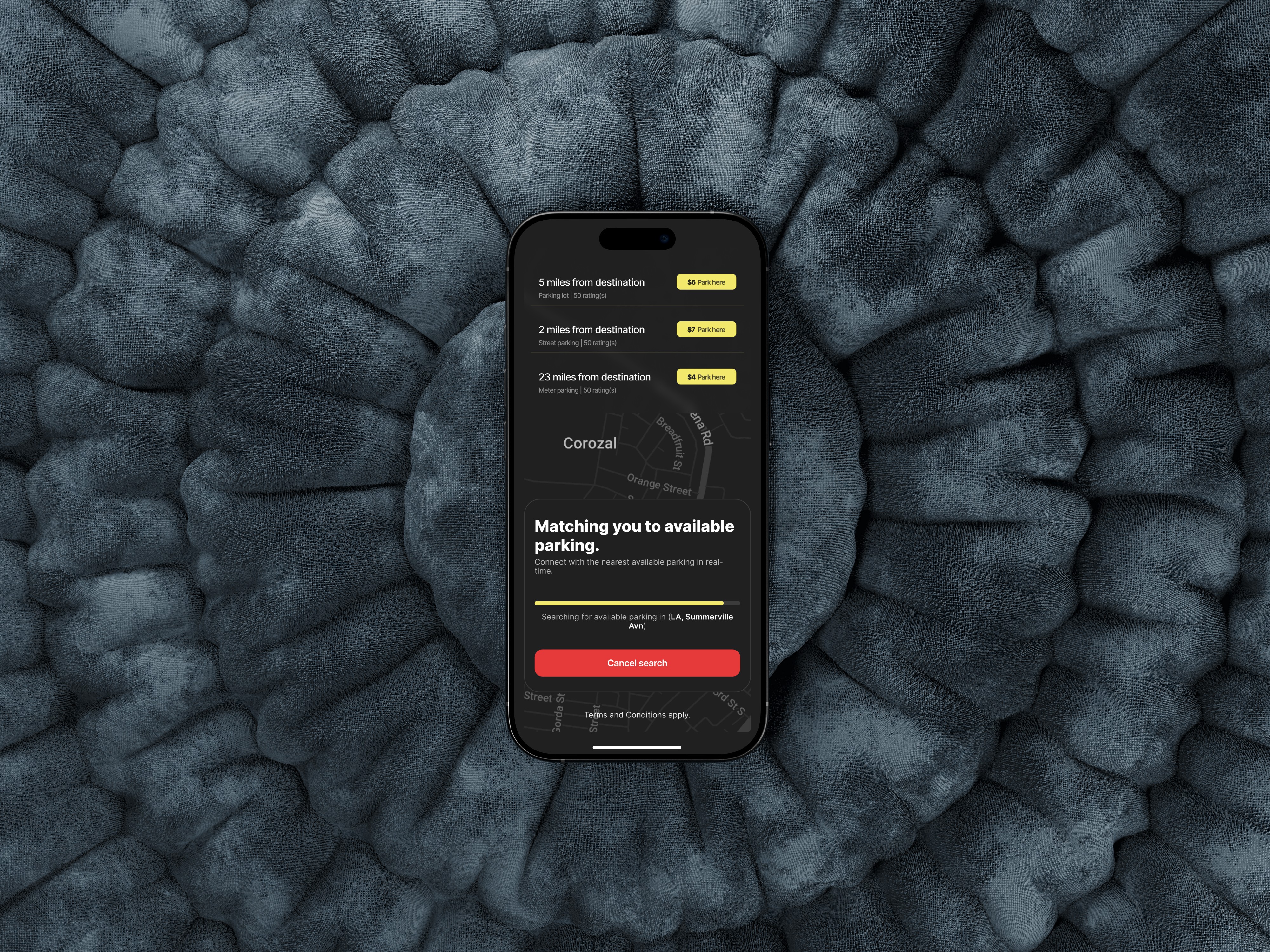
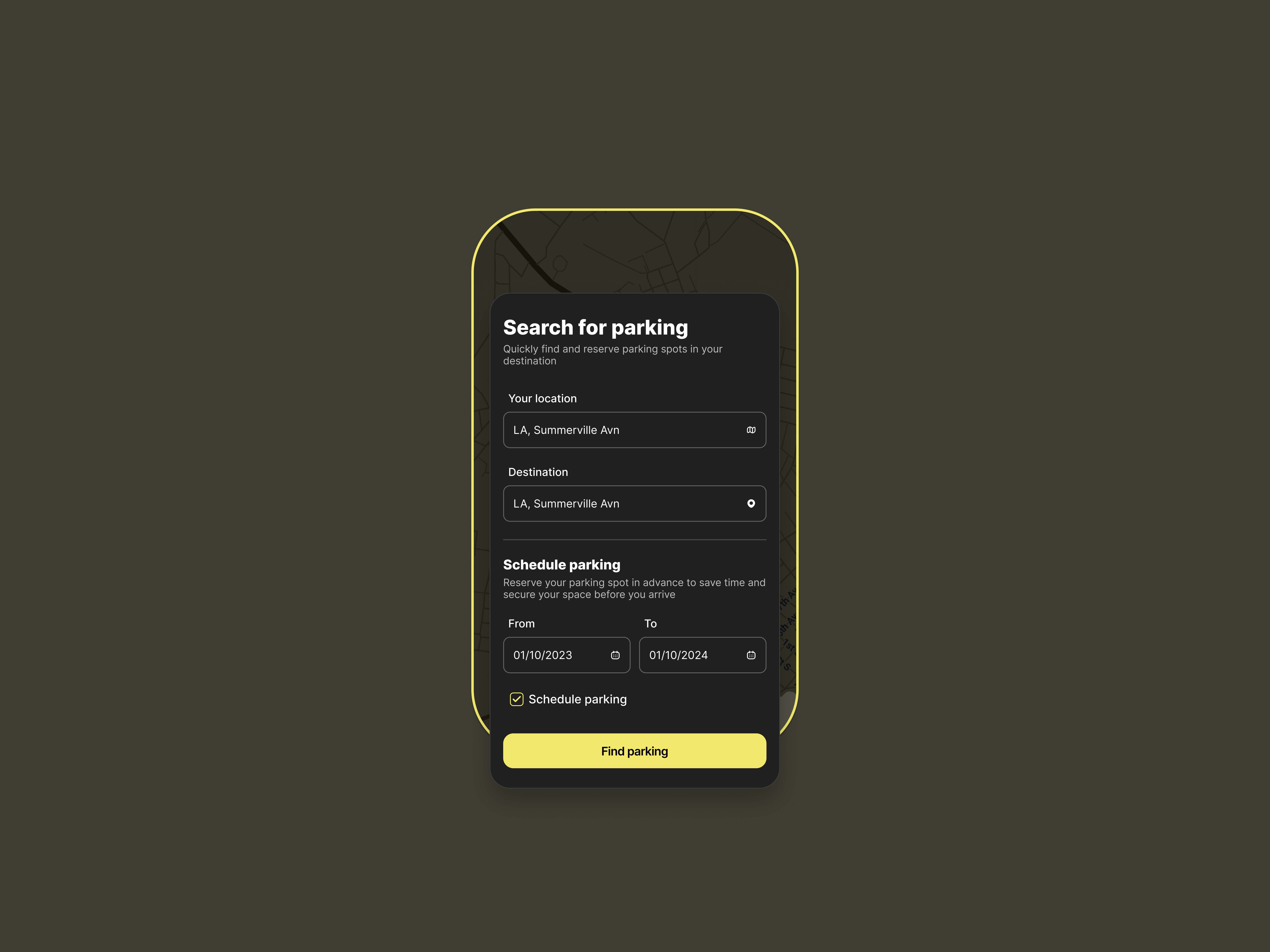
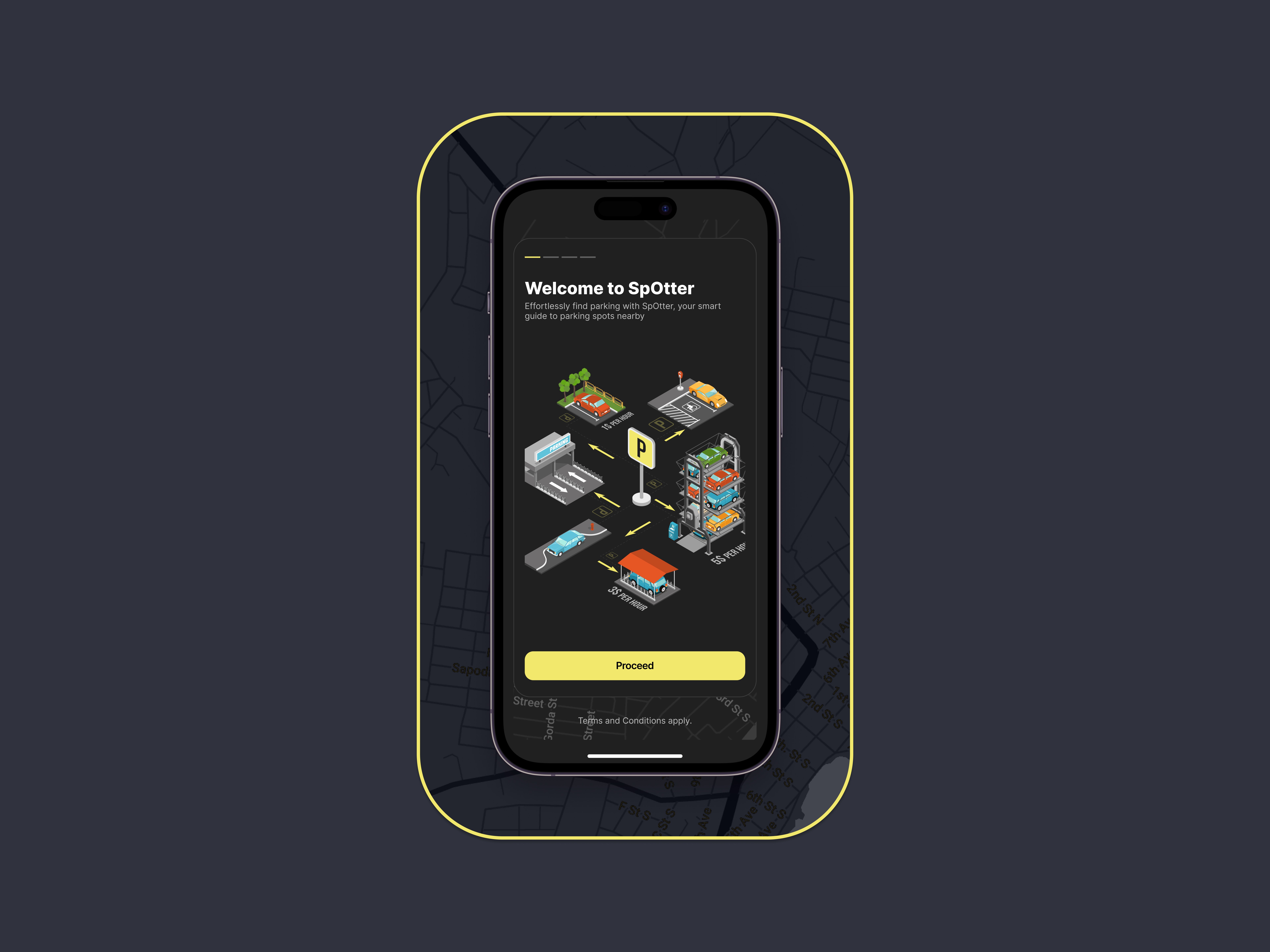
Spotter is a mobile marketplace to find nearby verified parking in seconds and sell idle spots safely. Who it serves: Drivers (commuters & event-goers) and spot owners (residents & businesses).
YEAR
2024
ROLE
PRODUCT DESIGNER
SERVICES
UX RESEARCH
MARKET RESEARCH
BRAND DESIGN
PRODUCT DESIGN
About the project
1) Executive summary
Goal: to make it effortless and trustworthy to
(a) find a space in <2 minutes and
(b) monetize an idle spot safely.
North-star outcome:
“time-to-park” ≤ 8 minutes from app open to parked, ≥ 70% of first-week users complete one booking or listing.
MVP pillars
Reliable discovery (live availability + clear fit: size, price, distance, safety).
Frictionless checkout (one-tap pay, extensions, refunds).
Lister confidence (easy calendar, pricing guardrails, photo-based verification).
Trust & safety (ID/KYC, license plate, dispute flows, guarantees).
2) Problem framing & market scan
Core problems for drivers
High cognitive load while moving: comparing distance, price, safety, and fit (SUV vs compact).
Uncertainty: “Will the spot actually be free?” “Is it safe?”
Last-mile stress: navigation ends at the block, not the entrance; unclear rules, fines.
Core problems for spot owners
Setup friction: photos, rules, calendar, pricing are tedious.
No-shows / misuse risk, payment timing.
Competitor snapshot (for positioning)
SpotHero/JustPark/ParkMobile: strong inventory & payments, limited peer-to-peer trust signals and granular fit (size/height) in many markets.
AirGarage: business lots, less peer-to-peer.
Opportunity: peer-to-peer liquidity + verifiable reliability (photo time-stamps, plate recognition, guarantees) + fast extensions.
3) Target users & proto-personas
A. Commuter Carla (Driver)
Needs predictable, affordable weekday parking near office/transit.
KPI: <2min to choose a spot, <5% booking failure.
B. Event Eli (Driver)
Evening/weekend demand spikes, willing to pay more for guaranteed proximity and extended hours.
KPI: minimal deviations (wrong entrance/closed gates).
C. Host Hakeem (Resident lister)
Spare driveway/space, wants simple set-and-forget listing and payout.
KPI: occupancy rate, zero disputes.
D. Manager Maya (Business lot)
Off-peak inventory (churches, schools, offices).
KPI: revenue per space, misuse reduction.
Jobs-to-be-done examples:
“When I’m circling a dense area, I want a guaranteed, legal spot I can trust, so I can stop worrying and get there on time.”
“When I have an unused driveway, I want to earn safely without hassles, so I can make passive income.”
4) Research
4.1 Generative
Contextual inquiry / ride-along (n=8–10): I observed search & park behavior (pre-drive vs in-flow), recorded decision cues (price, distance, lighting).
Diary study 2 weeks (n=20): logged parking attempts (success/fail, time-to-park, emotions).
Survey (n=200): willingness to pay, trust drivers (photo, ratings), deterrents (fines, tow risk).
Lister interviews (n=12): setup barriers, rule clarity, photo proof, payout expectations.
Key questions
Which top 3 attributes decide selection? (distance vs price vs safety vs covered/EV)
What trust signals actually reduce anxiety? (recent photo, license-plate check, “last verified 7m ago”)
What listing steps feel heavy?, what can we automate?
4.2 Evaluative (usability)
Unmoderated task tests (n=30 per flow):
1) Find & book under 2 minutes
2) Extend a session
3) List a driveway with calendar rules.
Metrics: SUS, task success, time on task, error rate, heatmaps.
4.3 Quant & analytics setup
Instrument used: search_started, results_viewed, filter_used, spot_selected, checkout_started, paid, navigate_started, arrived, extend, end_and_rate, list_created, availability_updated, dispute_opened.
Defined cohorts (commuter/event/host) + funnels (Search→Pay, List→First booking).
4.4 Safety & field testing
Pilot in 2 zones with mixed density, partner lots + vetted listers.
Incident protocol dry runs (blocked spot, wrong plate, tow risk).
5) Insights & UX hypotheses
Trust beats price by ~20–30% in last-minute decisions. Show “Verified X min ago,” recent photos, and plate/height fit first.
Choice overload hurts on mobile while moving. Default to two/three top picks: Closest good fit and Best value.
Extensions are common. Surface a sticky “+30m” one-tap extension throughout the session.
Listers undervalue time windows. Provide smart default pricing & blackout templates.
Photo evidence resolves disputes fast. Require arrival/exit photo prompts, automate with timestamp & geotag.
6) Product requirements (MVP)
6.1 Driver flow (core)
Search: destination or map pan, auto-detect ETA.
Results: ranked by fit score (distance × availability freshness × price × safety × fit [size/height/EV]).
Detail: entrance photos, rules, “last open 5m ago,” ratings, plate fit check, walking time.
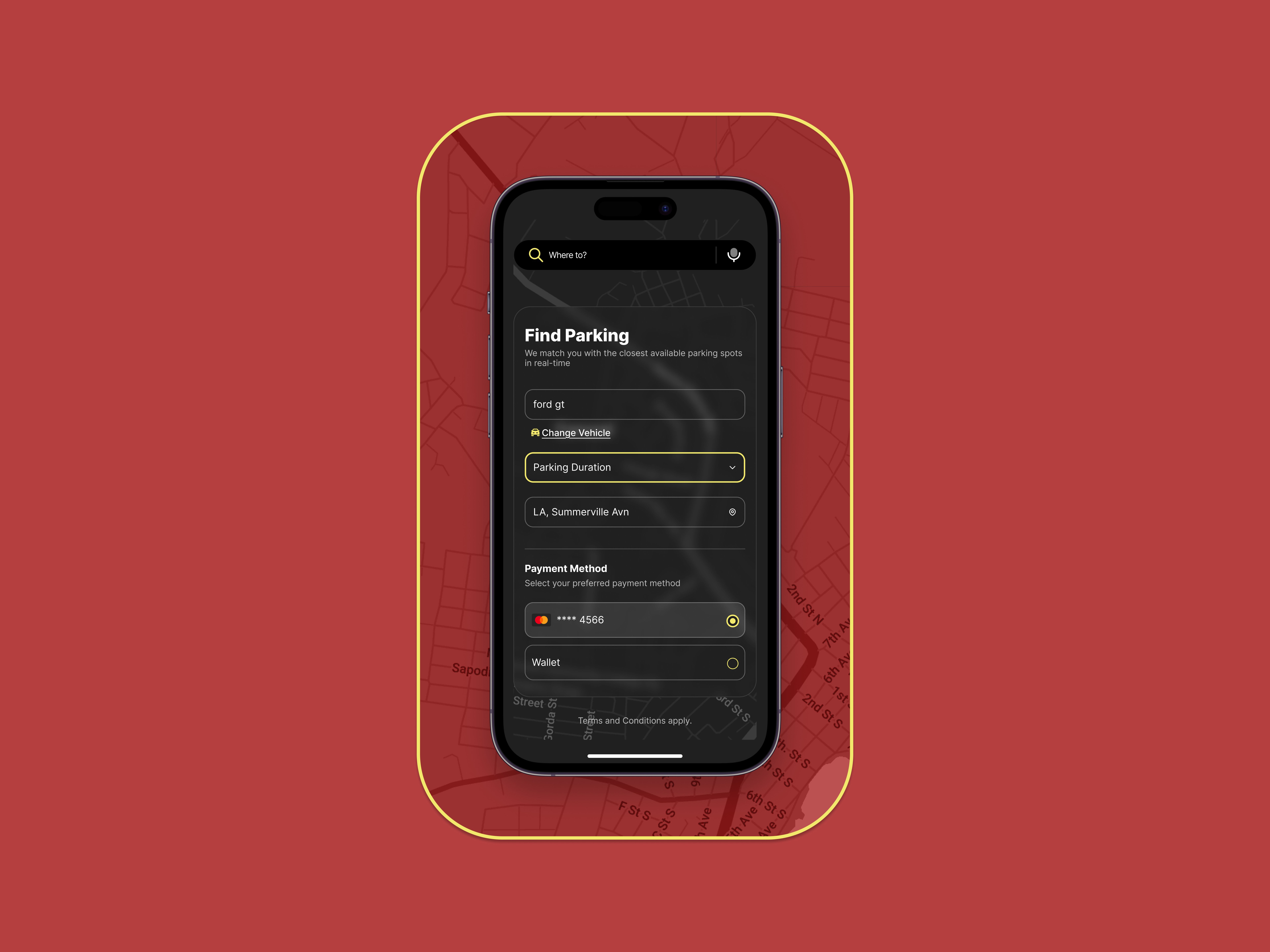
Pay: one-tap (saved card/wallet), clear cancellation window, terms.
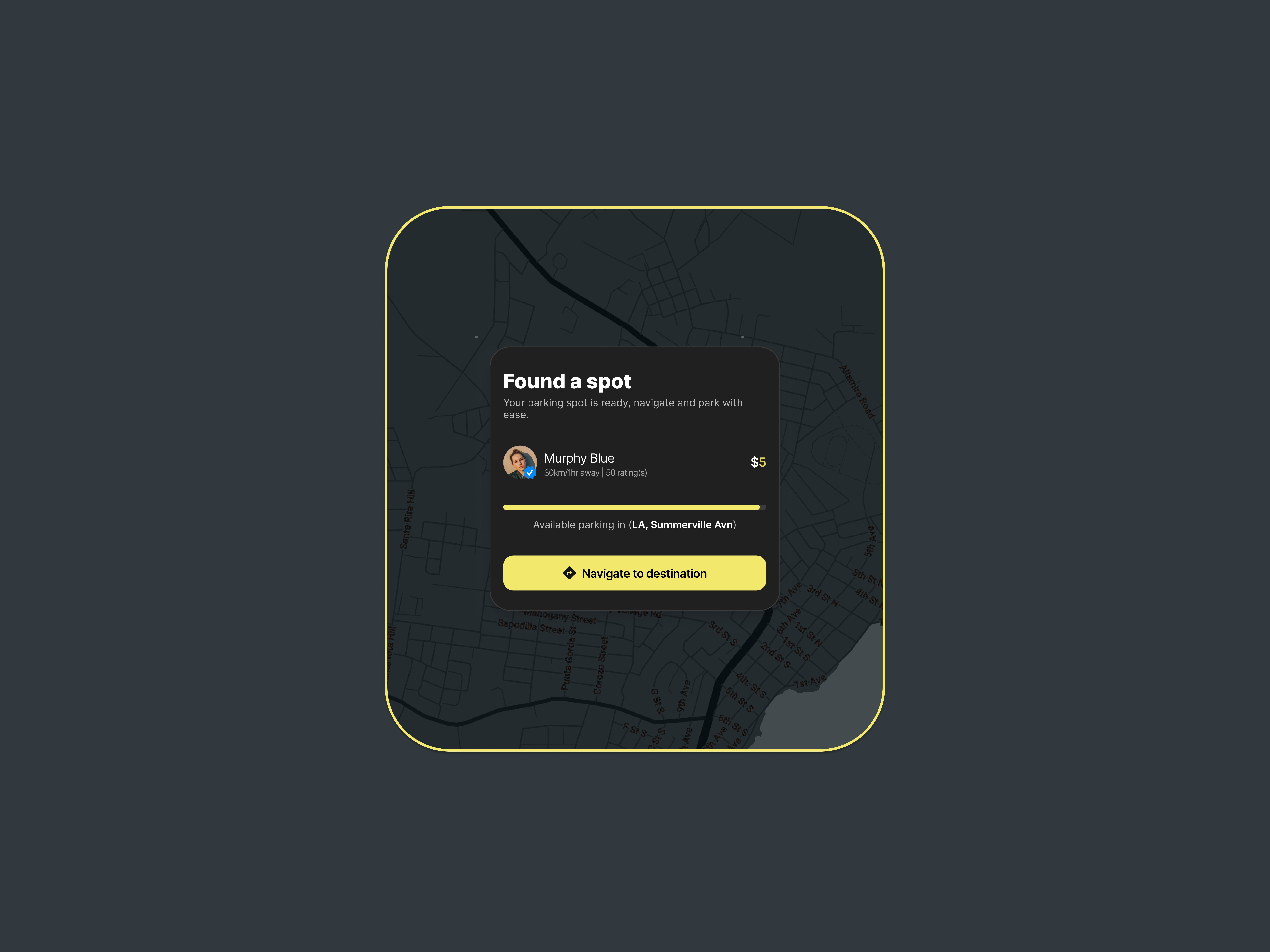
Navigate: exact entrance pin + gate code instruction card; “I’m here” check-in.
Session: timer, “Extend +15/+30”, support.
Exit: “End & add photo”, rate, receipt.
6.2 Lister flow (core)
Create listing: address pin, guided photos (entrance, spot, signage), size/height/EV, rules (no overnight, tow policy).
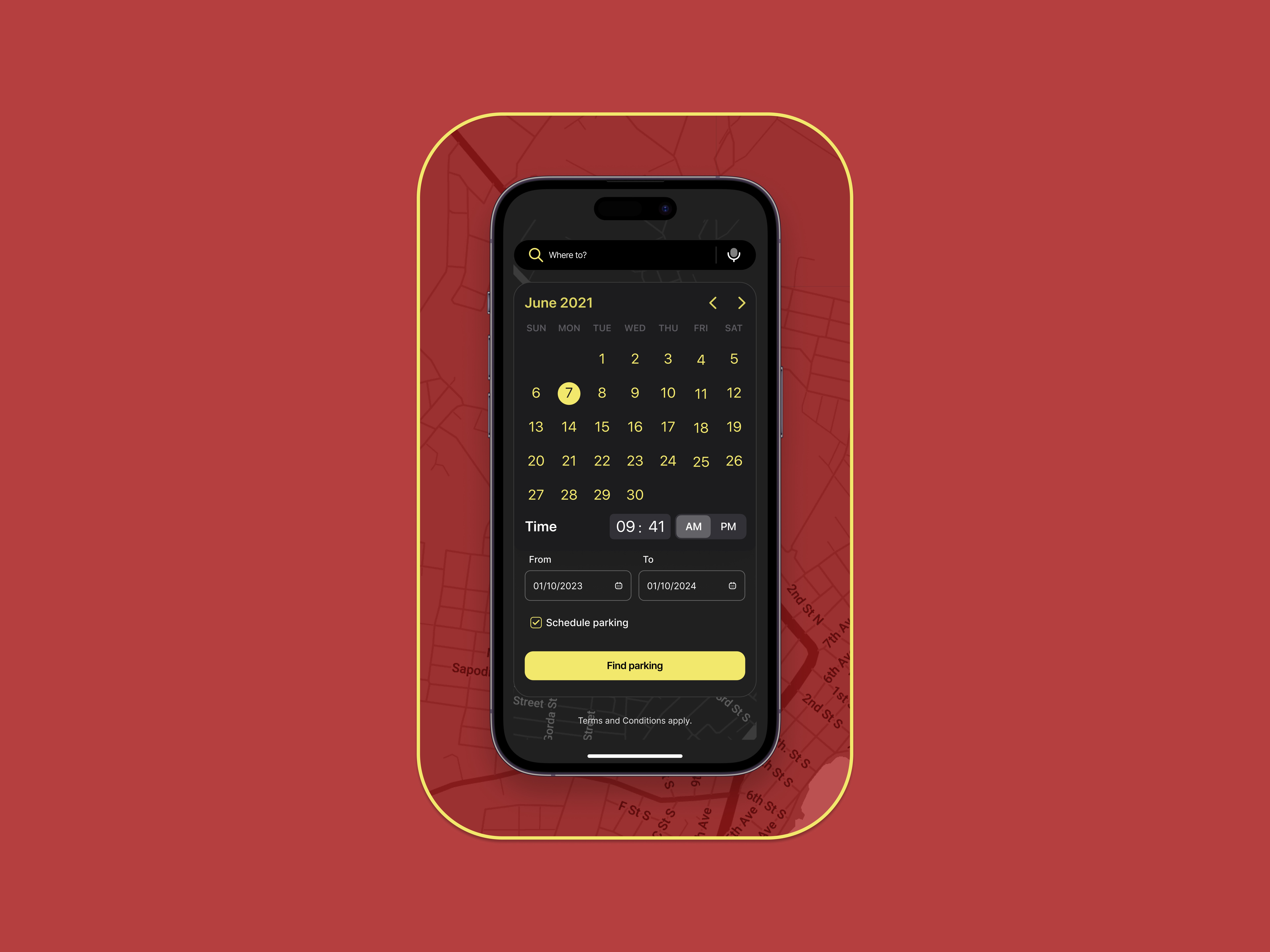
Availability & pricing: calendar templates (weekday commute, event nights), dynamic price suggestions.
Verification: ID + bank, optional plate reader for gated lots.
Live management: block dates, quick close, message buyer, dispute center.
Payouts: weekly/threshold, dashboard.
6.3 Cross-cutting
Trust: badging (“Super Host,” “Recently Verified”), safety blurbs, insurance/guarantee summary.
Support: chat escalation paths, 2-tap SOS for blocked/unsafe situations.
7) Information architecture
Entities: User, Vehicle, Payment Method, Listing, Spot (instance), Booking, Session, Dispute, Payout, Message.
Top-level nav: Find, Bookings, List/Manage, Wallet, Profile.
Empty states: teach/onboarding: “No listings yet” → CTA to add, “No bookings yet” → show nearby popular areas.
8) Key user flows
A) Find & book (happy path)
Homepage (search bar) → results (2 “smart picks” + list) → detail → pay → entrance card → timer.
Microcopy: “Verified 4 minutes ago • 120m walk • 1.9m height limit.”
Edge cases:
Spot becomes unavailable during pay → instant swap suggestions, price hold for 5 minutes.
Gate code failure → quick call/chat, auto-apply credit if unresolved in 3 min.
B) Extend parking
Sticky bar with remaining time, “Extend +30m” (shows new total & cost).
Auto-extend toggle with cap (user-defined).
C) List a spot
Camera coach marks (“Take entrance photo from the street, include gate”).
Rule presets: “No blocking sidewalk”, “Back-in only”, “Quiet hours”.
Calendar wizard: start with a template, smart price prompts based on demand.
D) Dispute & refund
Arrival photo vs lister’s current photo, if mismatch (car occupying), immediate cancel+credit, notify host.
Invisible queue for ops review, 24h payout hold on disputed bookings.
9) Design system snapshot
Color: Charcoal base, off-white text, yellow accents reserved for primary actions/state highlights.
Type: 16/24 body baseline, 28/36 for h2, tight numeric tabular for prices & timers.
Components: Search bar (with voice), Result card (photo, badges, price, walk time), Trust badge, Duration control, Payment sheet, Timer bar, Photo capture coach, Calendar grid.
States: loading (skeletal cards), empty (teach), error (retry, support CTA), offline (cached bookings + SMS backup for gate code).
10) Trust & safety model
Verification: Government ID + selfie (listers), plate capture on arrival (optional) to deter misuse.
Evidence: Mandatory arrival/exit photos; geotag + timestamp.
Guarantee: “Can’t access spot?” auto-credit + nearest alternative.
Ratings: Dual (driver & lister) with specific tags (clear signage, accurate photos, courteous).
Fraud checks: velocity limits, device fingerprinting, stolen-card heuristics.
11) Pricing & policy
Dynamic pricing suggestions from demand heatmaps (events, commute hours).
Cancellation: free until start−5min, after start, pro-rate with transparent fee.
No-show: auto-release after 10–15m, partial refund policy.
Host payout: weekly or instant (fee).
12) Measurement (KPIs & formulas)
Activation (drivers): first booking within 7 days / sign-ups.
Search→Book conversion: paid / search_started.
Time-to-decision: median from results loaded → pay.
Availability freshness: median minutes since last verification.
Fill rate (hosts): booked_hours / available_hours.
Cancellation rate, Dispute rate, On-time arrival %.
CSAT/NPS after session.
Rate on bookings.
13) Experiment roadmap
Ranking: “Trust-weighted” vs “Price-weighted” default.
Card layout: map-first vs list-first, 2-3smart picks vs full list.
Trust badge variants: “Verified X min ago” vs “Live sensor” vs “Super Host”.
Extension nudges: reminder at T−10m vs persistent sticky vs push.
Listing wizard: photo coach on/off, effect on disputes & conversion.
14) Usability test (MVP)
Tasks (10–12 minutes each):
Find and book a spot near “LA Summerville Ave” for 90 minutes.
Extend by 30 minutes mid-session.
Create a listing with weekday-only availability and “no overnight” rule.
Success thresholds:
≥85% task success, median decision time ≤ 90s, SUS ≥ 80.
Critical error rate ≤ 5%.
Observation checklist:
Do users notice “height limit”?
Do they trust the verification stamp more than star ratings?
Where do they hesitate?
15) H.E.A.T (Human Experience Audit Toolkit) - My framework audit on critical screens
Emotion Mapping: pre-booking anxiety ↓ via verification stamps, entrance photos, and “guarantee” copy above CTA.
Cognitive Load Simulation: to keep choices to 2–3 recommended cards, expose filters (EV/covered/security) as quick chips.
Dark Pattern Forensics: transparent fees, show total cost before pay, no default opt-ins.
Loop Fatigue: store vehicle & payment, one-tap repeat of recent destination.
Cultural Contrast: units (ft/m), currency, iconography (no text-only signs), right-to-left readiness.
Interface Soundcheck: subtle haptics and short earcon on “Booked” and “Extended”.
Bored Teen Test: single thumb, 5 taps max from open to paid.
16) Content & microcopy
Result card: “2 min walk • Covered • Verified 7m ago • 1.9m max height”
Guarantee: “If your spot is blocked, we’ll rebook you nearby or refund instantly.”
Photo coach: “Stand on the sidewalk. Capture the entrance including any signs.”
Extension prompt: “Running late? +30m ($6.50). Ends 7:40 PM.”
17) Technical notes
Availability freshness: combines host calendar, optional sensor/IoT, and user “I’ve arrived/left” signals.
Maps: door-to-entrance pin + indoor/lot overlays, precise geofences for “I’m here.”
Offline mode: cache booking + gate code, SMS fallbacks.
Performance: results in <800ms, prefetch detail for top 2 cards.
Privacy: stores location with strict retention, clear opt-ins, PCI-compliant payments.
18) Launch plan (alpha → beta)
Alpha (closed): 200 drivers, 50 hosts in two neighborhoods, concierge support.
Beta (open waitlist): event partnerships (stadiums), business lots off-hours, referral codes.
Success gates: Search→Pay ≥ 25%, Disputes ≤ 2%, Fill rate ≥ 40% weekday, CSAT ≥ 4.5/5.
Smooth Scroll
This will hide itself!
This will hide itself!
Spotter.
OVERVIEW
Spotter is a mobile marketplace to find nearby verified parking in seconds and sell idle spots safely. Who it serves: Drivers (commuters & event-goers) and spot owners (residents & businesses).
YEAR
2024
ROLE
PRODUCT DESIGNER
SERVICES
UX RESEARCH
MARKET RESEARCH
BRAND DESIGN
PRODUCT DESIGN
About the project
1) Executive summary
Goal: to make it effortless and trustworthy to
(a) find a space in <2 minutes and
(b) monetize an idle spot safely.
North-star outcome:
“time-to-park” ≤ 8 minutes from app open to parked, ≥ 70% of first-week users complete one booking or listing.
MVP pillars
Reliable discovery (live availability + clear fit: size, price, distance, safety).
Frictionless checkout (one-tap pay, extensions, refunds).
Lister confidence (easy calendar, pricing guardrails, photo-based verification).
Trust & safety (ID/KYC, license plate, dispute flows, guarantees).
2) Problem framing & market scan
Core problems for drivers
High cognitive load while moving: comparing distance, price, safety, and fit (SUV vs compact).
Uncertainty: “Will the spot actually be free?” “Is it safe?”
Last-mile stress: navigation ends at the block, not the entrance; unclear rules, fines.
Core problems for spot owners
Setup friction: photos, rules, calendar, pricing are tedious.
No-shows / misuse risk, payment timing.
Competitor snapshot (for positioning)
SpotHero/JustPark/ParkMobile: strong inventory & payments, limited peer-to-peer trust signals and granular fit (size/height) in many markets.
AirGarage: business lots, less peer-to-peer.
Opportunity: peer-to-peer liquidity + verifiable reliability (photo time-stamps, plate recognition, guarantees) + fast extensions.
3) Target users & proto-personas
A. Commuter Carla (Driver)
Needs predictable, affordable weekday parking near office/transit.
KPI: <2min to choose a spot, <5% booking failure.
B. Event Eli (Driver)
Evening/weekend demand spikes, willing to pay more for guaranteed proximity and extended hours.
KPI: minimal deviations (wrong entrance/closed gates).
C. Host Hakeem (Resident lister)
Spare driveway/space, wants simple set-and-forget listing and payout.
KPI: occupancy rate, zero disputes.
D. Manager Maya (Business lot)
Off-peak inventory (churches, schools, offices).
KPI: revenue per space, misuse reduction.
Jobs-to-be-done examples:
“When I’m circling a dense area, I want a guaranteed, legal spot I can trust, so I can stop worrying and get there on time.”
“When I have an unused driveway, I want to earn safely without hassles, so I can make passive income.”
4) Research
4.1 Generative
Contextual inquiry / ride-along (n=8–10): I observed search & park behavior (pre-drive vs in-flow), recorded decision cues (price, distance, lighting).
Diary study 2 weeks (n=20): logged parking attempts (success/fail, time-to-park, emotions).
Survey (n=200): willingness to pay, trust drivers (photo, ratings), deterrents (fines, tow risk).
Lister interviews (n=12): setup barriers, rule clarity, photo proof, payout expectations.
Key questions
Which top 3 attributes decide selection? (distance vs price vs safety vs covered/EV)
What trust signals actually reduce anxiety? (recent photo, license-plate check, “last verified 7m ago”)
What listing steps feel heavy?, what can we automate?
4.2 Evaluative (usability)
Unmoderated task tests (n=30 per flow):
1) Find & book under 2 minutes
2) Extend a session
3) List a driveway with calendar rules.
Metrics: SUS, task success, time on task, error rate, heatmaps.
4.3 Quant & analytics setup
Instrument used: search_started, results_viewed, filter_used, spot_selected, checkout_started, paid, navigate_started, arrived, extend, end_and_rate, list_created, availability_updated, dispute_opened.
Defined cohorts (commuter/event/host) + funnels (Search→Pay, List→First booking).
4.4 Safety & field testing
Pilot in 2 zones with mixed density, partner lots + vetted listers.
Incident protocol dry runs (blocked spot, wrong plate, tow risk).
5) Insights & UX hypotheses
Trust beats price by ~20–30% in last-minute decisions. Show “Verified X min ago,” recent photos, and plate/height fit first.
Choice overload hurts on mobile while moving. Default to two/three top picks: Closest good fit and Best value.
Extensions are common. Surface a sticky “+30m” one-tap extension throughout the session.
Listers undervalue time windows. Provide smart default pricing & blackout templates.
Photo evidence resolves disputes fast. Require arrival/exit photo prompts, automate with timestamp & geotag.
6) Product requirements (MVP)
6.1 Driver flow (core)
Search: destination or map pan, auto-detect ETA.
Results: ranked by fit score (distance × availability freshness × price × safety × fit [size/height/EV]).
Detail: entrance photos, rules, “last open 5m ago,” ratings, plate fit check, walking time.
Pay: one-tap (saved card/wallet), clear cancellation window, terms.
Navigate: exact entrance pin + gate code instruction card; “I’m here” check-in.
Session: timer, “Extend +15/+30”, support.
Exit: “End & add photo”, rate, receipt.
6.2 Lister flow (core)
Create listing: address pin, guided photos (entrance, spot, signage), size/height/EV, rules (no overnight, tow policy).
Availability & pricing: calendar templates (weekday commute, event nights), dynamic price suggestions.
Verification: ID + bank, optional plate reader for gated lots.
Live management: block dates, quick close, message buyer, dispute center.
Payouts: weekly/threshold, dashboard.
6.3 Cross-cutting
Trust: badging (“Super Host,” “Recently Verified”), safety blurbs, insurance/guarantee summary.
Support: chat escalation paths, 2-tap SOS for blocked/unsafe situations.
7) Information architecture
Entities: User, Vehicle, Payment Method, Listing, Spot (instance), Booking, Session, Dispute, Payout, Message.
Top-level nav: Find, Bookings, List/Manage, Wallet, Profile.
Empty states: teach/onboarding: “No listings yet” → CTA to add, “No bookings yet” → show nearby popular areas.
8) Key user flows
A) Find & book (happy path)
Homepage (search bar) → results (2 “smart picks” + list) → detail → pay → entrance card → timer.
Microcopy: “Verified 4 minutes ago • 120m walk • 1.9m height limit.”
Edge cases:
Spot becomes unavailable during pay → instant swap suggestions, price hold for 5 minutes.
Gate code failure → quick call/chat, auto-apply credit if unresolved in 3 min.
B) Extend parking
Sticky bar with remaining time, “Extend +30m” (shows new total & cost).
Auto-extend toggle with cap (user-defined).
C) List a spot
Camera coach marks (“Take entrance photo from the street, include gate”).
Rule presets: “No blocking sidewalk”, “Back-in only”, “Quiet hours”.
Calendar wizard: start with a template, smart price prompts based on demand.
D) Dispute & refund
Arrival photo vs lister’s current photo, if mismatch (car occupying), immediate cancel+credit, notify host.
Invisible queue for ops review, 24h payout hold on disputed bookings.
9) Design system snapshot
Color: Charcoal base, off-white text, yellow accents reserved for primary actions/state highlights.
Type: 16/24 body baseline, 28/36 for h2, tight numeric tabular for prices & timers.
Components: Search bar (with voice), Result card (photo, badges, price, walk time), Trust badge, Duration control, Payment sheet, Timer bar, Photo capture coach, Calendar grid.
States: loading (skeletal cards), empty (teach), error (retry, support CTA), offline (cached bookings + SMS backup for gate code).
10) Trust & safety model
Verification: Government ID + selfie (listers), plate capture on arrival (optional) to deter misuse.
Evidence: Mandatory arrival/exit photos; geotag + timestamp.
Guarantee: “Can’t access spot?” auto-credit + nearest alternative.
Ratings: Dual (driver & lister) with specific tags (clear signage, accurate photos, courteous).
Fraud checks: velocity limits, device fingerprinting, stolen-card heuristics.
11) Pricing & policy
Dynamic pricing suggestions from demand heatmaps (events, commute hours).
Cancellation: free until start−5min, after start, pro-rate with transparent fee.
No-show: auto-release after 10–15m, partial refund policy.
Host payout: weekly or instant (fee).
12) Measurement (KPIs & formulas)
Activation (drivers): first booking within 7 days / sign-ups.
Search→Book conversion: paid / search_started.
Time-to-decision: median from results loaded → pay.
Availability freshness: median minutes since last verification.
Fill rate (hosts): booked_hours / available_hours.
Cancellation rate, Dispute rate, On-time arrival %.
CSAT/NPS after session.
Rate on bookings.
13) Experiment roadmap
Ranking: “Trust-weighted” vs “Price-weighted” default.
Card layout: map-first vs list-first, 2-3smart picks vs full list.
Trust badge variants: “Verified X min ago” vs “Live sensor” vs “Super Host”.
Extension nudges: reminder at T−10m vs persistent sticky vs push.
Listing wizard: photo coach on/off, effect on disputes & conversion.
14) Usability test (MVP)
Tasks (10–12 minutes each):
Find and book a spot near “LA Summerville Ave” for 90 minutes.
Extend by 30 minutes mid-session.
Create a listing with weekday-only availability and “no overnight” rule.
Success thresholds:
≥85% task success, median decision time ≤ 90s, SUS ≥ 80.
Critical error rate ≤ 5%.
Observation checklist:
Do users notice “height limit”?
Do they trust the verification stamp more than star ratings?
Where do they hesitate?
15) H.E.A.T (Human Experience Audit Toolkit) - My framework audit on critical screens
Emotion Mapping: pre-booking anxiety ↓ via verification stamps, entrance photos, and “guarantee” copy above CTA.
Cognitive Load Simulation: to keep choices to 2–3 recommended cards, expose filters (EV/covered/security) as quick chips.
Dark Pattern Forensics: transparent fees, show total cost before pay, no default opt-ins.
Loop Fatigue: store vehicle & payment, one-tap repeat of recent destination.
Cultural Contrast: units (ft/m), currency, iconography (no text-only signs), right-to-left readiness.
Interface Soundcheck: subtle haptics and short earcon on “Booked” and “Extended”.
Bored Teen Test: single thumb, 5 taps max from open to paid.
16) Content & microcopy
Result card: “2 min walk • Covered • Verified 7m ago • 1.9m max height”
Guarantee: “If your spot is blocked, we’ll rebook you nearby or refund instantly.”
Photo coach: “Stand on the sidewalk. Capture the entrance including any signs.”
Extension prompt: “Running late? +30m ($6.50). Ends 7:40 PM.”
17) Technical notes
Availability freshness: combines host calendar, optional sensor/IoT, and user “I’ve arrived/left” signals.
Maps: door-to-entrance pin + indoor/lot overlays, precise geofences for “I’m here.”
Offline mode: cache booking + gate code, SMS fallbacks.
Performance: results in <800ms, prefetch detail for top 2 cards.
Privacy: stores location with strict retention, clear opt-ins, PCI-compliant payments.
18) Launch plan (alpha → beta)
Alpha (closed): 200 drivers, 50 hosts in two neighborhoods, concierge support.
Beta (open waitlist): event partnerships (stadiums), business lots off-hours, referral codes.
Success gates: Search→Pay ≥ 25%, Disputes ≤ 2%, Fill rate ≥ 40% weekday, CSAT ≥ 4.5/5.
Smooth Scroll
This will hide itself!
This will hide itself!
Spotter.
OVERVIEW
Spotter is a mobile marketplace to find nearby verified parking in seconds and sell idle spots safely. Who it serves: Drivers (commuters & event-goers) and spot owners (residents & businesses).
YEAR
2024
ROLE
PRODUCT DESIGNER
SERVICES
UX RESEARCH
MARKET RESEARCH
BRAND DESIGN
PRODUCT DESIGN
About the project
1) Executive summary
Goal: to make it effortless and trustworthy to
(a) find a space in <2 minutes and
(b) monetize an idle spot safely.
North-star outcome:
“time-to-park” ≤ 8 minutes from app open to parked, ≥ 70% of first-week users complete one booking or listing.
MVP pillars
Reliable discovery (live availability + clear fit: size, price, distance, safety).
Frictionless checkout (one-tap pay, extensions, refunds).
Lister confidence (easy calendar, pricing guardrails, photo-based verification).
Trust & safety (ID/KYC, license plate, dispute flows, guarantees).
2) Problem framing & market scan
Core problems for drivers
High cognitive load while moving: comparing distance, price, safety, and fit (SUV vs compact).
Uncertainty: “Will the spot actually be free?” “Is it safe?”
Last-mile stress: navigation ends at the block, not the entrance; unclear rules, fines.
Core problems for spot owners
Setup friction: photos, rules, calendar, pricing are tedious.
No-shows / misuse risk, payment timing.
Competitor snapshot (for positioning)
SpotHero/JustPark/ParkMobile: strong inventory & payments, limited peer-to-peer trust signals and granular fit (size/height) in many markets.
AirGarage: business lots, less peer-to-peer.
Opportunity: peer-to-peer liquidity + verifiable reliability (photo time-stamps, plate recognition, guarantees) + fast extensions.
3) Target users & proto-personas
A. Commuter Carla (Driver)
Needs predictable, affordable weekday parking near office/transit.
KPI: <2min to choose a spot, <5% booking failure.
B. Event Eli (Driver)
Evening/weekend demand spikes, willing to pay more for guaranteed proximity and extended hours.
KPI: minimal deviations (wrong entrance/closed gates).
C. Host Hakeem (Resident lister)
Spare driveway/space, wants simple set-and-forget listing and payout.
KPI: occupancy rate, zero disputes.
D. Manager Maya (Business lot)
Off-peak inventory (churches, schools, offices).
KPI: revenue per space, misuse reduction.
Jobs-to-be-done examples:
“When I’m circling a dense area, I want a guaranteed, legal spot I can trust, so I can stop worrying and get there on time.”
“When I have an unused driveway, I want to earn safely without hassles, so I can make passive income.”
4) Research
4.1 Generative
Contextual inquiry / ride-along (n=8–10): I observed search & park behavior (pre-drive vs in-flow), recorded decision cues (price, distance, lighting).
Diary study 2 weeks (n=20): logged parking attempts (success/fail, time-to-park, emotions).
Survey (n=200): willingness to pay, trust drivers (photo, ratings), deterrents (fines, tow risk).
Lister interviews (n=12): setup barriers, rule clarity, photo proof, payout expectations.
Key questions
Which top 3 attributes decide selection? (distance vs price vs safety vs covered/EV)
What trust signals actually reduce anxiety? (recent photo, license-plate check, “last verified 7m ago”)
What listing steps feel heavy?, what can we automate?
4.2 Evaluative (usability)
Unmoderated task tests (n=30 per flow):
1) Find & book under 2 minutes
2) Extend a session
3) List a driveway with calendar rules.
Metrics: SUS, task success, time on task, error rate, heatmaps.
4.3 Quant & analytics setup
Instrument used: search_started, results_viewed, filter_used, spot_selected, checkout_started, paid, navigate_started, arrived, extend, end_and_rate, list_created, availability_updated, dispute_opened.
Defined cohorts (commuter/event/host) + funnels (Search→Pay, List→First booking).
4.4 Safety & field testing
Pilot in 2 zones with mixed density, partner lots + vetted listers.
Incident protocol dry runs (blocked spot, wrong plate, tow risk).
5) Insights & UX hypotheses
Trust beats price by ~20–30% in last-minute decisions. Show “Verified X min ago,” recent photos, and plate/height fit first.
Choice overload hurts on mobile while moving. Default to two/three top picks: Closest good fit and Best value.
Extensions are common. Surface a sticky “+30m” one-tap extension throughout the session.
Listers undervalue time windows. Provide smart default pricing & blackout templates.
Photo evidence resolves disputes fast. Require arrival/exit photo prompts, automate with timestamp & geotag.
6) Product requirements (MVP)
6.1 Driver flow (core)
Search: destination or map pan, auto-detect ETA.
Results: ranked by fit score (distance × availability freshness × price × safety × fit [size/height/EV]).
Detail: entrance photos, rules, “last open 5m ago,” ratings, plate fit check, walking time.
Pay: one-tap (saved card/wallet), clear cancellation window, terms.
Navigate: exact entrance pin + gate code instruction card; “I’m here” check-in.
Session: timer, “Extend +15/+30”, support.
Exit: “End & add photo”, rate, receipt.
6.2 Lister flow (core)
Create listing: address pin, guided photos (entrance, spot, signage), size/height/EV, rules (no overnight, tow policy).
Availability & pricing: calendar templates (weekday commute, event nights), dynamic price suggestions.
Verification: ID + bank, optional plate reader for gated lots.
Live management: block dates, quick close, message buyer, dispute center.
Payouts: weekly/threshold, dashboard.
6.3 Cross-cutting
Trust: badging (“Super Host,” “Recently Verified”), safety blurbs, insurance/guarantee summary.
Support: chat escalation paths, 2-tap SOS for blocked/unsafe situations.
7) Information architecture
Entities: User, Vehicle, Payment Method, Listing, Spot (instance), Booking, Session, Dispute, Payout, Message.
Top-level nav: Find, Bookings, List/Manage, Wallet, Profile.
Empty states: teach/onboarding: “No listings yet” → CTA to add, “No bookings yet” → show nearby popular areas.
8) Key user flows
A) Find & book (happy path)
Homepage (search bar) → results (2 “smart picks” + list) → detail → pay → entrance card → timer.
Microcopy: “Verified 4 minutes ago • 120m walk • 1.9m height limit.”
Edge cases:
Spot becomes unavailable during pay → instant swap suggestions, price hold for 5 minutes.
Gate code failure → quick call/chat, auto-apply credit if unresolved in 3 min.
B) Extend parking
Sticky bar with remaining time, “Extend +30m” (shows new total & cost).
Auto-extend toggle with cap (user-defined).
C) List a spot
Camera coach marks (“Take entrance photo from the street, include gate”).
Rule presets: “No blocking sidewalk”, “Back-in only”, “Quiet hours”.
Calendar wizard: start with a template, smart price prompts based on demand.
D) Dispute & refund
Arrival photo vs lister’s current photo, if mismatch (car occupying), immediate cancel+credit, notify host.
Invisible queue for ops review, 24h payout hold on disputed bookings.
9) Design system snapshot
Color: Charcoal base, off-white text, yellow accents reserved for primary actions/state highlights.
Type: 16/24 body baseline, 28/36 for h2, tight numeric tabular for prices & timers.
Components: Search bar (with voice), Result card (photo, badges, price, walk time), Trust badge, Duration control, Payment sheet, Timer bar, Photo capture coach, Calendar grid.
States: loading (skeletal cards), empty (teach), error (retry, support CTA), offline (cached bookings + SMS backup for gate code).
10) Trust & safety model
Verification: Government ID + selfie (listers), plate capture on arrival (optional) to deter misuse.
Evidence: Mandatory arrival/exit photos; geotag + timestamp.
Guarantee: “Can’t access spot?” auto-credit + nearest alternative.
Ratings: Dual (driver & lister) with specific tags (clear signage, accurate photos, courteous).
Fraud checks: velocity limits, device fingerprinting, stolen-card heuristics.
11) Pricing & policy
Dynamic pricing suggestions from demand heatmaps (events, commute hours).
Cancellation: free until start−5min, after start, pro-rate with transparent fee.
No-show: auto-release after 10–15m, partial refund policy.
Host payout: weekly or instant (fee).
12) Measurement (KPIs & formulas)
Activation (drivers): first booking within 7 days / sign-ups.
Search→Book conversion: paid / search_started.
Time-to-decision: median from results loaded → pay.
Availability freshness: median minutes since last verification.
Fill rate (hosts): booked_hours / available_hours.
Cancellation rate, Dispute rate, On-time arrival %.
CSAT/NPS after session.
Rate on bookings.
13) Experiment roadmap
Ranking: “Trust-weighted” vs “Price-weighted” default.
Card layout: map-first vs list-first, 2-3smart picks vs full list.
Trust badge variants: “Verified X min ago” vs “Live sensor” vs “Super Host”.
Extension nudges: reminder at T−10m vs persistent sticky vs push.
Listing wizard: photo coach on/off, effect on disputes & conversion.
14) Usability test (MVP)
Tasks (10–12 minutes each):
Find and book a spot near “LA Summerville Ave” for 90 minutes.
Extend by 30 minutes mid-session.
Create a listing with weekday-only availability and “no overnight” rule.
Success thresholds:
≥85% task success, median decision time ≤ 90s, SUS ≥ 80.
Critical error rate ≤ 5%.
Observation checklist:
Do users notice “height limit”?
Do they trust the verification stamp more than star ratings?
Where do they hesitate?
15) H.E.A.T (Human Experience Audit Toolkit) - My framework audit on critical screens
Emotion Mapping: pre-booking anxiety ↓ via verification stamps, entrance photos, and “guarantee” copy above CTA.
Cognitive Load Simulation: to keep choices to 2–3 recommended cards, expose filters (EV/covered/security) as quick chips.
Dark Pattern Forensics: transparent fees, show total cost before pay, no default opt-ins.
Loop Fatigue: store vehicle & payment, one-tap repeat of recent destination.
Cultural Contrast: units (ft/m), currency, iconography (no text-only signs), right-to-left readiness.
Interface Soundcheck: subtle haptics and short earcon on “Booked” and “Extended”.
Bored Teen Test: single thumb, 5 taps max from open to paid.
16) Content & microcopy
Result card: “2 min walk • Covered • Verified 7m ago • 1.9m max height”
Guarantee: “If your spot is blocked, we’ll rebook you nearby or refund instantly.”
Photo coach: “Stand on the sidewalk. Capture the entrance including any signs.”
Extension prompt: “Running late? +30m ($6.50). Ends 7:40 PM.”
17) Technical notes
Availability freshness: combines host calendar, optional sensor/IoT, and user “I’ve arrived/left” signals.
Maps: door-to-entrance pin + indoor/lot overlays, precise geofences for “I’m here.”
Offline mode: cache booking + gate code, SMS fallbacks.
Performance: results in <800ms, prefetch detail for top 2 cards.
Privacy: stores location with strict retention, clear opt-ins, PCI-compliant payments.
18) Launch plan (alpha → beta)
Alpha (closed): 200 drivers, 50 hosts in two neighborhoods, concierge support.
Beta (open waitlist): event partnerships (stadiums), business lots off-hours, referral codes.
Success gates: Search→Pay ≥ 25%, Disputes ≤ 2%, Fill rate ≥ 40% weekday, CSAT ≥ 4.5/5.
Smooth Scroll
This will hide itself!
This will hide itself!